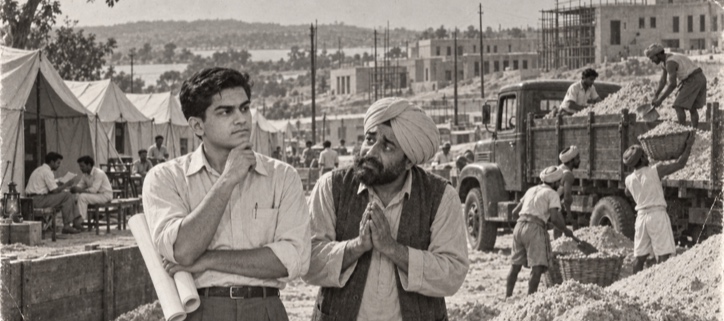
In 1956, about a month before the formation of the new state of Madhya Pradesh, I was transferred from Hinganghat to Bhopal to work on the Bhopal Capital Project.
Bhopal at that time was a very different place from what it later became. The new capital was still taking shape. Housing for officers had not yet been built, since we were the builders. So, we stayed in tents. In a way, we were not merely working on the new capital—we were camping inside it while it was being created.
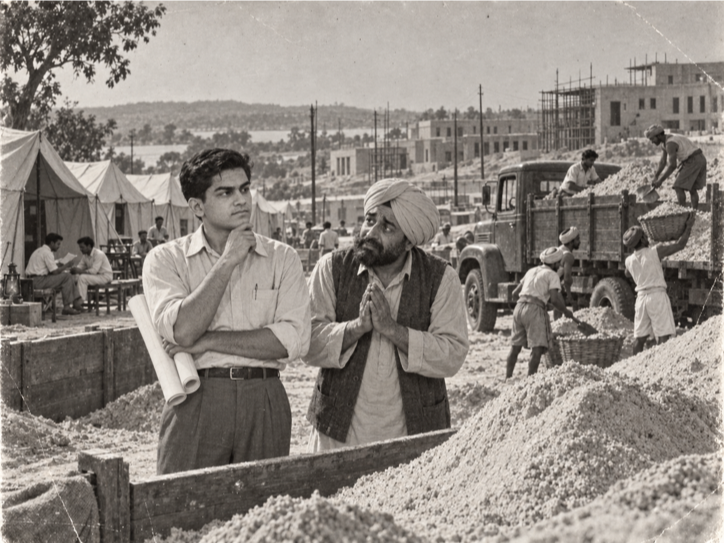
I was put in charge of a new subdivision and was also asked to take over a large government store from the former Bhopal administration as the departments were being reorganized.
Among the more important items in the store was a very large quantity of Narmada sand. With so many government buildings under construction, sand was in constant demand.
My storekeeper was a Punjabi gentleman who, like me, had only recently arrived on transfer from the Nagpur side. So both of us were newcomers to Bhopal and still learning its ways. He was thoroughly honest, very decent, and exceptionally mild-mannered. He was so polite that he was the sort of man who would probably apologize if somebody stepped on his foot.
Soon after I took charge, I went to Nagpur for four days of casual leave to visit my parents.
That apparently was enough time for a problem to develop in my sand store.
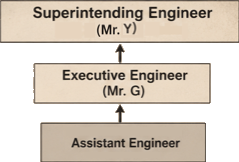
While I was away, the Executive Engineer, Mr. G, came to the store and instructed the storekeeper to issue sand to several contractors. The transactions themselves were official. The contractors paid the prescribed price, receipts were issued, and the quantities were entered in the records.
The difficulty was that the quantities actually loaded onto the trucks were sometimes greater than the quantities paid for.
A contractor who paid for 100 cubic feet might leave with considerably more, being liberal with his takings. My poor storekeeper, still new to the Bhopal working style, found himself faced with a senior officer giving instructions and contractors loading material quickly without me on duty.
He did not have the confidence to stop them.
When I returned from Nagpur, I found him in a miserable condition. He was almost in tears.
“Sir, what could I do?” was his explanation.
I could understand his predicament, but the shortage still had to be accounted for.
So I told him, “First, let us establish exactly where we stand. Stack the remaining sand properly, take the measurements, and tell me how much we are short.”
He did so.
The shortage was substantial.
I then went to the Superintending Engineer, Mr. Y, and explained the situation. I pointed out that the store was under my charge and that the issues had taken place while I was away.
He listened and then gave me a very practical answer. The material had already been issued, receipts had been given, and the storekeeper had allowed the excess quantities to leave.
In effect, his message was: “It has happened. Now you have to manage it.”
That was the end of my appeal.
I had not taken the sand. I had not authorized the excess issue. I had not even been in Bhopal when it happened.
But the shortage was now my responsibility.
Fortunately, at that time there had been heavy flooding in the Narmada, which had made sand difficult to obtain. Private contractors were therefore eager to buy sand from the government stock.
So I devised a solution.
I told the storekeeper, “If somebody pays for 100 cubic feet, issue the receipt for 100 cubic feet—but give him actually 95.”
He looked at me rather uncertainly.
“Only 95, sir?”
“Yes. Ninety-five.”
Naturally, the contractors asked why.
“How can you charge us for 100 and give us only 95?”
My answer was simple: “You do not have to buy it.”
That was usually enough.
The reason was straightforward. Even at 95 cubic feet for the price of 100, our sand was still cheaper than what they could obtain in the open market. So after some discussion, most of them accepted the arrangement and took the sand.
Some came directly to me.
“Sir, your storekeeper is giving only 95!”
“Yes,” I said. “That is my instruction.”
“But we are paying for 100.”
“Yes.”
“Then why only 95?”
“Because that is the quantity I am prepared to issue.”
There was not much more to discuss after that.
No money was being diverted. Every rupee went through the official system and every buyer received the appropriate receipt. The difference remained in the store, and gradually the physical stock began catching up with the stock register.
For a few days, the system continued.
Then one morning the storekeeper came to me looking much happier.
“Sir, I checked again.”
“And?”
“The shortage is gone.”
He paused.
“In fact, sir, I think we may now have a little extra.”
That was the point to stop.
I immediately told him, “Fine. Stop selling to private contractors. From now onward, the sand is only for government work.”
And that was the end of the Bhopal sand problem.
It was one of the first difficult situations I encountered as an Assistant Engineer, and it taught me something that stayed with me throughout my career.
In management, it is quite possible to be completely innocent and still be held responsible.
You may be away. Your subordinate may be inexperienced in the local working style. A senior officer may have made a decision in your absence. None of those facts changes the need to solve the problem once it reaches you.
That is when management actually begins.
It also taught me something about people. My storekeeper was honest and hardworking. His problem was not honesty or ability; he was simply new to the environment and not naturally forceful. Once I gave him clear instructions and made it clear that I would stand behind him, however, he had no difficulty telling the contractors:
“Assistant Engineer’s orders.”
Sometimes a person does not need to become tougher. He simply needs clear authority and the confidence that his superior will support him.
Looking back, I remember many larger projects from those years. But I still remember the tents, the unfinished capital, the piles of Narmada sand, and one very worried storekeeper who, like me, was still getting used to Bhopal.
The buildings of Bhopal taught me engineering.
The missing sand taught me management.