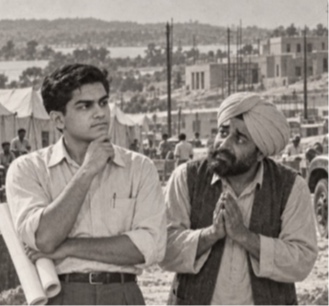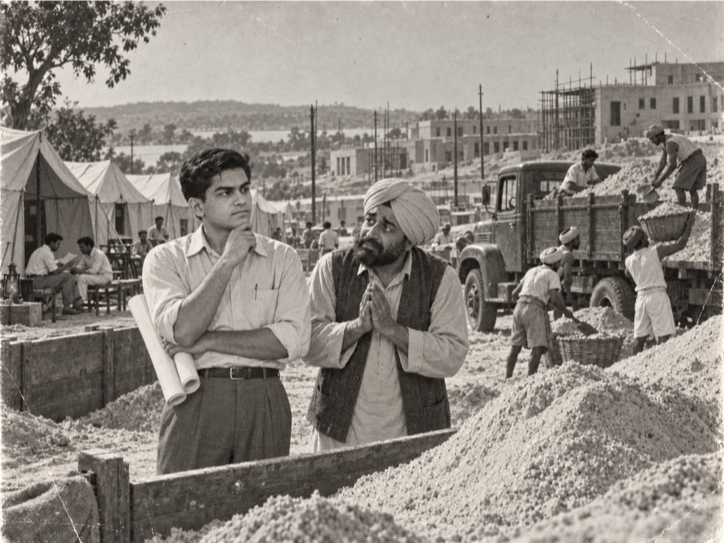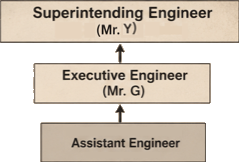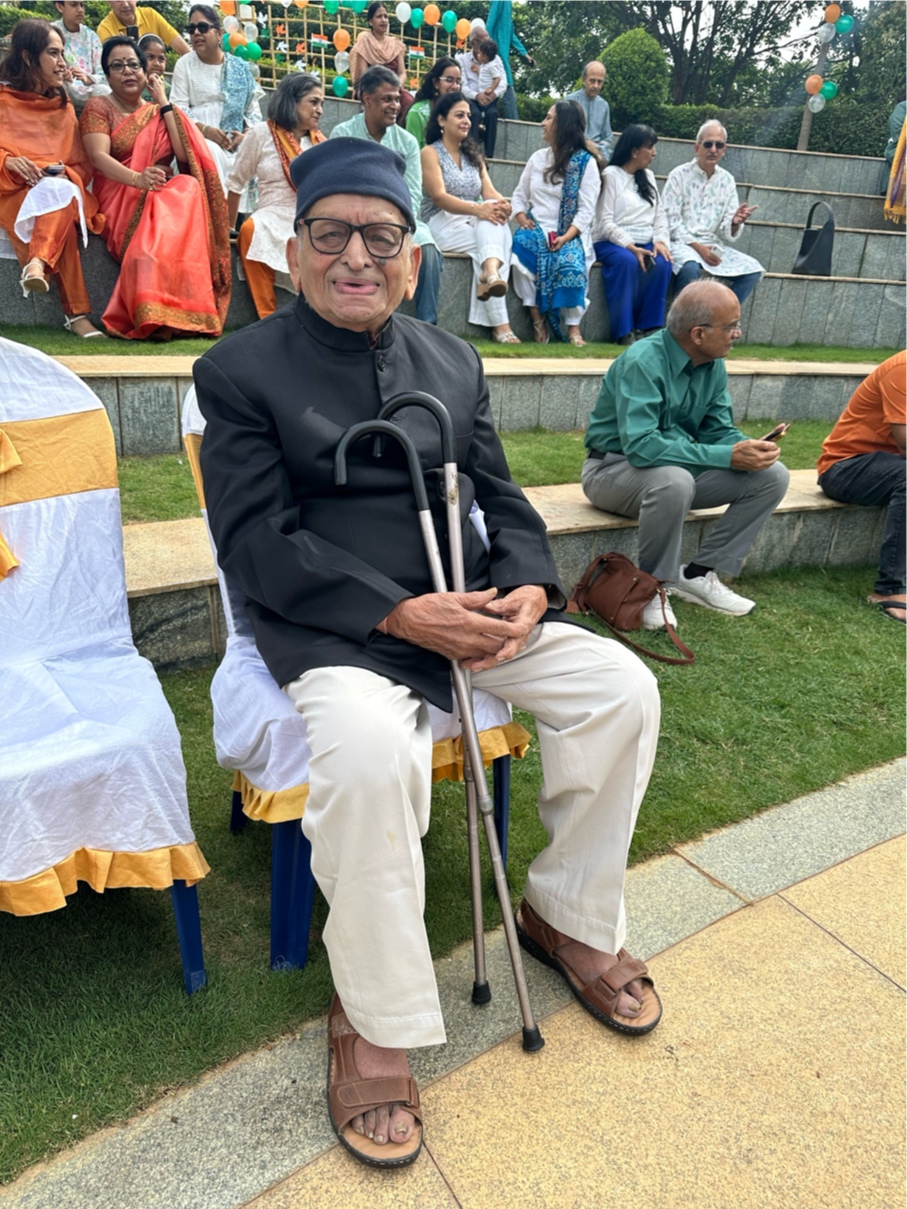
About sixty-three years ago, I was posted in Bhopal as an Executive Engineer. I had been transferred from Raipur and was looking after construction work through three subdivisions. At that time, the Chief Engineer, dissatisfied with the working of the Mechanical Division, decided to give me additional charge of that division as well.
One of the subdivisions had a very large store containing various materials, including a substantial stock of steel bars.
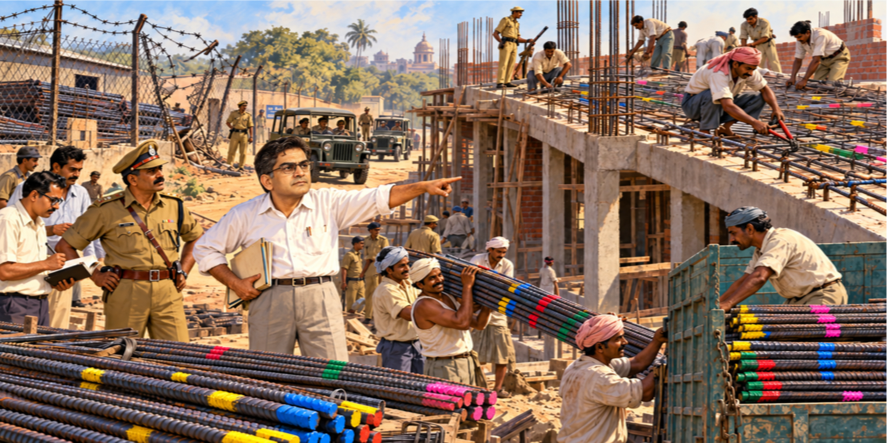
The steel arrived by rail in BFR wagons and was transported from the railway yard to our store. It was properly entered in the records and placed in a large open storage area.
The yard was fenced, although “fenced” may be too generous a word. It was protected mainly by barbed wire and optimism.
There were chowkidars at night, a storekeeper responsible for the stock, a Subdivisional Officer responsible for the store, and ultimately, of course, an Executive Engineer who would be asked to explain everything if anything went wrong.
That last person was me.
A Small Habit That Suddenly Became Very Useful
I had introduced one practice that, at the time, some people thought was unnecessary.
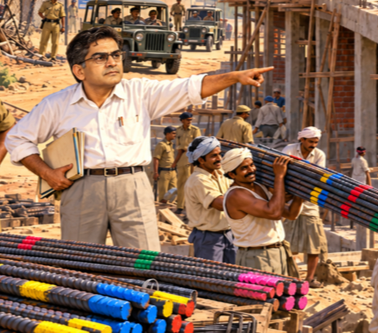
Every consignment of steel was given its own color code. A batch might have yellow paint at the ends and blue in the middle. Another might use red and green. We used combinations of yellow, green, red, blue, pink and other colors, and the corresponding code was entered in the store records.
People objected.
“Sir, इसमें खर्च होगा. बहुत महंगा खर्च।”
It will cost money.
My answer was simple: “Do it. Add it to the issue price.”
It was a trivial cost.
Nobody else seemed particularly interested in copying the idea. Perhaps painting steel was considered beneath the dignity of engineering.
Then one morning, I visited the store.
A section of the fence had been broken.
A very large quantity of steel had disappeared.
Apparently, somebody had arrived during the night with trucks and helped themselves.
Suddenly, my “unnecessary” colored paint became extremely interesting.
We knew exactly which batch had been stolen.
The Search Begins
We immediately lodged an FIR at TT Nagar Police Station.
Then I called all three Subdivisional Officers.
I told them to stop what they were doing, take their staff and jeeps, and form search squads. The city was divided into sectors and each team was sent out to inspect places where construction work was going on.
The instructions were simple:
Look for recently delivered steel.
Then look at the paint marks.
One person was left in the office to answer telephone calls and deal with communications. Everyone else went hunting for steel.
This was apparently not regarded by everyone as proper administrative procedure.
Some helpful colleagues began observing that I had practically stopped the work of three subdivisions without permission.
“This fellow is taking the law into his own hands.”
“He has not taken approval from the Chief Engineer.”
“He is running the department in his own fashion.”
All of this was probably true.
But I had one small problem with following the normal sequence of government correspondence:
The thieves were unlikely to wait for our file to complete its circulation.
At Four O’Clock, the Telephone Rang
There were no mobile phones then. If somebody wanted to contact you from the field, they first had to find a telephone.
At about four o’clock, one of the search teams called.
“Sir, we have seen it. Please come.”
I went immediately.
They had found a large house under construction near Lakshmi Talkies.
There was our steel.
But the situation was even more urgent than we had expected.
The house was ready for concreting of an entire roof slab. The stolen steel bars had already been cut to size, bent, tied with binding wire, and placed in position as reinforcement.
Everything was ready for the concrete to be poured.
Once that slab had been concreted, almost all visible evidence would have disappeared inside the structure. We could hardly have expected to break open an entire reinforced concrete roof later merely to prove where the steel had come from.
We had reached the site just in time.
The work was stopped immediately.
And there, still visible on the bars, were our color markings.
For once, paint had become forensic evidence.
Following the Trail
We called the police.
The owner of the house was questioned about where he had bought the steel. From him, we obtained the address of the supplier’s godown.
So the police, our staff and I went there.
The godown was locked.
The man there explained that unfortunately he did not have the key.
The person who had the key was apparently not available.
There were several explanations.
None improved with repetition.
Eventually, the lock ceased to be an obstacle.
Inside was the balance of our stolen steel.
A very large quantity of it.
Color-coded and waiting for us.
The Police Inspector decided that the supplier should be arrested, and the owner of the house who had bought the stolen material was also taken into custody.
At the construction site, the reinforcement that had already been cut, bent, tied and placed for the roof slab had to be dismantled.
All of it was recovered.
Now We Had Another Problem: Where Do You Put Recovered Stolen Steel?
We naturally wanted to take the recovered steel directly back to the departmental store.
The police said no.
Since it was evidence, it first had to go to the police station.
Fair enough.
The police then asked us to arrange the trucks.
Naturally.
So the department whose steel had been stolen arranged the trucks and labor to recover its own stolen steel and transport it to the police station.
We loaded it.
We drove it there.
We unloaded it.
After the necessary police formalities, the steel was then shifted back into safe custody at the departmental store.
Within approximately 24 hours, the theft had been reported, the stolen batch identified, the city searched, the steel located at the construction site, the remaining stock traced to the godown, the material recovered, brought to the police station, and ultimately returned to the departmental store.
That was quite a day’s work.
Then Came the Explanation
By now, news had naturally reached the higher authorities.
A strict note arrived.
How had I stopped the work of three subdivisions?
Who had authorized me to deploy everybody across the city?
Why had I acted without first taking approval?
My response was essentially this:
Yes, I had done all those things.
And within 24 hours, we had recovered the entire stolen property.
There was not much more to discuss.
The government apparently came to the same conclusion. The matter against me went no further.
I was later transferred, so I did not follow every detail of the court proceedings. But the important part, from my point of view, had already happened.
We had got the steel back.
The Lesson I Took Away
There are occasions when procedures are essential.
And there are occasions when the first requirements are judgment and speed of action.
Had we spent that day writing letters, asking for approval, constituting a committee and determining the appropriate jurisdiction, the concrete roof would probably have been poured.
Once that happened, the most important physical evidence would literally have been buried in concrete.
Instead, we acted immediately.
And one small system that had seemed almost silly—painting colored marks on steel bars—made the entire recovery possible.
So perhaps there are three lessons.
Good controls often look unnecessary until the day they are needed.
In an emergency, somebody has to make a decision.
And never underestimate the investigative power of a tin of paint.
I must admit, when the last of that steel came back into the store, I felt rather like a hero.
At least until the next government note arrived.