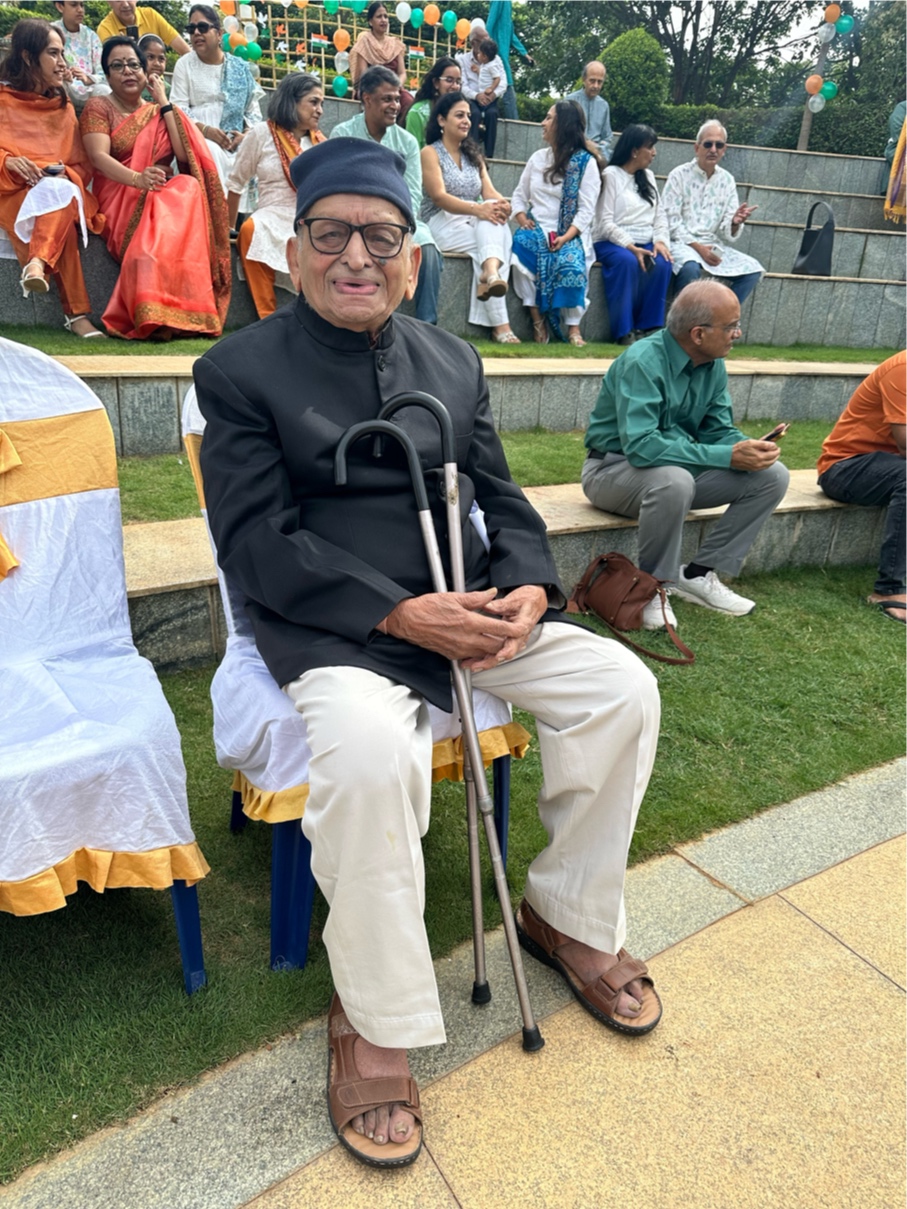
Speaker 1 (Introduction): Small introduction is only meant for comparatively newcomers to our colony. We can always see him around in his motorized wheelchair inside our colonies. He is the favorite of all of us.
Born to Tamil parents in Nagpur, where he had his initial education, he passed out with an Honors degree in Civil Engineering in 1951. He joined the MP Engineering Services as an Assistant Engineer in November 1952, and rose to the position of Engineer-in-Chief, and retired from active government service finally as the Chief Technical Examiner, Vigilance.
During his service, he ably executed several highways and building projects—special mention of the Civil Secretariat building known as Vallabh Bhavan. As Managing Director of MP Bridges Construction Corporation, he has several bridges to his credit. Post-retirement, he gave his voluntary services to the Royal Commonwealth Society for the Blind, whose chairperson was Princess Diana, for the construction of an eye hospital for Bhopal gas tragedy victims and a similar hospital at Indore.
He was a regular arbitrator for several engineering disputes and claims. After 1997, he stopped his remunerative services and solely devoted to social work and regular visits to his children and grandchildren in USA.
He now mostly restricts himself to his books, back in his bachelor armchair after the passing away of his wife eight months ago. I now hand over the mic to Srinivasan mama, Srinivasan uncle, Srinivasan tata, as he is known here. And we are very eagerly waiting for his 70 years of experience, to listen to some of the stories which we had not witnessed. Thank you.
Speaker 2 (Shri Srinivasan):
Plural/correct form:
देवियों एवं सज्जनों
एवं उपस्थित महानुभावों
एवं मेरे प्यारे बच्चों—
स्वतंत्रता दिवस की अस्सीवीं वर्षगांठ पर आप सबको हार्दिक शुभकामनाएं।
Greetings to all on this 80th Independence Day.
I have been fortunate to have been born before 1930 at Nagpur in central India, where people could congregate from all directions into huge congregations for all types of freedom fights in those days. Our house was fortunately facing the biggest maidan of Nagpur, where I was privileged at a young age to hear lectures of distinguished leaders like Mahatma Gandhi ji, Sardar Patel, Bhimrao Ambedkar, and several others on the independence movements.
Then came, of course, the 14th August 1947. The Constituent Assembly was summoned to meet on the night of 14th August 1947 in the then Parliament House, and the Prime Minister, Nehru, delivered his iconic lifetime address to the Parliament and the nation. And I quote a few sentences from his emotional speech:
“Long years ago, we made a tryst with destiny, and the time comes now to redeem our pledge. At the stroke of the midnight hour, when the world sleeps, India will awake to life and freedom. A moment comes, which comes rarely in history, when we step out from the old to the new, when an age ends, and when the soul of a nation, long suppressed, finds utterance…”
—and so on and so forth was the reading.
I was in my engineering college at Jabalpur during the declaration of independence. It was thrilling to see and feel a sense of great pride and a sudden sense of freedom when our national flag went for the first time raised by a freedom fighter of Jabalpur, Seth Govind Das. I have been fortunate to attend each Swatantrata Diwas ever since till now.
But freedom did not arrive with happiness alone. Already there was a general gloom in the atmosphere because of the cruel massacres of innocent Hindus and Muslims which were taking place daily, shamelessly, when they were moving from one country to the other. People on foot, on bullock carts, vans, trains, and a huge population was on the move—unimaginable. The Radcliffe Award was announced, but two days late. So again there was heavy—the biggest killing took place when the Radcliffe Award was announced on 17th August, two days later. And the maximum killing took place. Because suddenly they found—while the previous day they thought they were within India, next day they found they were, it is demarcated, we have still to go five miles further. There was again a huge killing.
Refugees from Delhi, refugees were all rehabilitated gradually in the various states by the Rehabilitation Ministry, which was a tremendous task. Even in our engineering college, after a month and a half, one student was admitted from the Karachi Engineering College. More than 565 princely states were given the option to stay separately or accede to one of the countries. And if they had been allowed to separately stay, what would have been the condition today? Condition in India would have been in tatters, in torn condition. Sardar Vallabhbhai Patel, assisted by the able V. P. Menon, using a policy of carrot and stick and the four principles of Sāma, Dāna, Bheda and finally Daṇḍa (साम, दान, भेद, दण्ड), brought round all, including the Hyderabad Nizam and the Nawab of Junagadh. The French peacefully transferred Pondicherry and Karaikal, but the Portuguese Goan area had to be brought under force.
All these took four years. And I would recommend you to read Narayani Basu’s book on V. P. Menon, The Unsung Architect of Modern India.
The nation had its biggest shock later, five months later, when the Mahatma was assassinated. Gandhiji personally led the country to freedom through his peaceful non-cooperation and civil disobedience movements which he taught to us. Everyone in the country felt that the patriarch of their own family has been suddenly taken away. I had the satisfaction of attending his asthi visarjan (अस्थि विसर्जन).
Few memories have stayed with me all my life. Our middle school headmaster, a perfect Gandhian, who was a nationalist, used to take us by bus every year to Sevagram, Wardha—50 miles away from Nagpur—to have a darshan (दर्शन) of Gandhiji. I went to Sevagram for three successive years when I finally went to my high school. The aura of his presence, very near as he passed by you, and the effect it has on one is indescribable. It had to be felt, and the effect it has on your life for long.
The second thing in my memory is that of Frontier Gandhi, the non-violent apostle of peace, gigantic leader of North-West Frontier Province. He was 6 feet 4 inches tall and always stood out in any crowd; above the crowd he was jutting out like that. It was a very nice sight. Khan Abdul Ghaffar Khan, leader of the Khudai Khidmatgar, also known as the Red Shirts. Because of his same ideology and close friendship with Mahatma Gandhi, he always attended the annual Congress meetings and opposed the division of the country. On division being agreed to, he wanted the North-West Frontier Province of the Pathans to be integrated with India. The Congress did not agree for several reasons. The Frontier Gandhi felt that they had been betrayed. He openly said, “We are being thrown to the wolves.” We couldn’t help it. We awarded him the Bharat Ratna in 1987.
The third is that of Subhas Chandra Bose, who felt freedom can only be achieved by force. He escaped to Germany via Gomoh railway station—Gomoh railway station is now renamed as Netaji Subhash Chandra Bose Junction. He escaped then to Germany in 1941, then went to Japan and formed the Indian National Army from Indian POWs with the Japanese and Indian expatriates staying in Burma, and had even planned to invade and capture Aizawl and Imphal in India. Sadly, he died in a plane crash while flying from Taipei to Tokyo.
Protecting our freedom and sovereignty is a heavy responsibility. Millions were rehabilitated commendably, and everyone has since prospered responsibly as Indian citizens. All sectors of the country have developed into a modern state. Institutions were created: steel plants, labs, irrigation projects, and what not. In my lifetime, I have seen India move from being a huge importer of grains, milk, and other necessities. We have now become big exporters of milk and grains. Once a country struggling for food and milk with huge shortages, Dr. Verghese Kurien revolutionized milk production with unimaginably mammoth-sized cooperatives in the world, and now our milk is being exported and sold in American store shelves. Scientists like Dr. M. S. Swaminathan helped transform agriculture, establishing rice research institutes in rice-growing areas, and with this introduction of high-yielding dwarf varieties of wheat and paddy made India an exporter. Dr. Homi Bhabha, father of the Indian nuclear program, and various hundreds of unsung heroes have made India what it is today.
But we are still spending trillions in importing pulses, vegetable oils, fertilizers, and fuels. Still a big job for our agriculture scientists to do. We have built satellites, software companies, and much more—dams, universities, research laboratories. Big firms, corporations, universities, research establishments have to work in unison to innovate commercially viable technologies to make India a Vishwa Guru (विश्वगुरु). We have to invest tremendously in research and development.
And the search and improvement continues and will continue. Every generation has its own tests. Our generation saw colonial rule, freedom, partition, suffering, building of a new nation. Now the present generation sees artificial intelligence, climate changes, new kinds of war, new kinds of inequality, and a world where knowledge moves faster than ever before.
A Viksit Bharat (विकसित भारत) will not be created by mere speeches alone. It can only be created with schools and institutions of excellence, with researchers, talented teachers, etc. It will be created when our children are not mere holders of diplomas and degrees on paper, but problem solvers and skilled workers. It will be created when technology is used not for comfort and luxury, but for courage and service.
Our population also has exploded from 30 crores in the undivided India of yore to 140 crores of divided India. So there is enough work for the next generation. We wish the Generation Z and the further, the Generation Alpha coming up, and they surely will tackle all problems with determination, skill, and diplomacy.
Thank you all for the patient hearing you gave me.
सबको सहन-शक्ति के लिए मैं आभारी हूँ।
सर्वे जनाः सुखिनो भवन्तु।
जय हिन्द!
